[ Case Study ] · 2026
From Aggregation Hotspot Prediction to Risk Mitigation: Improving MEDI-1912 Developability
Structure-Guided Engineering of a Difficult-to-Develop Antibody
A structure-guided workflow that uses computational aggregation hotspot prediction in Schrödinger BioLuminate to redesign MEDI-1912, lower aggregation risk, and improve developability without sacrificing target binding.
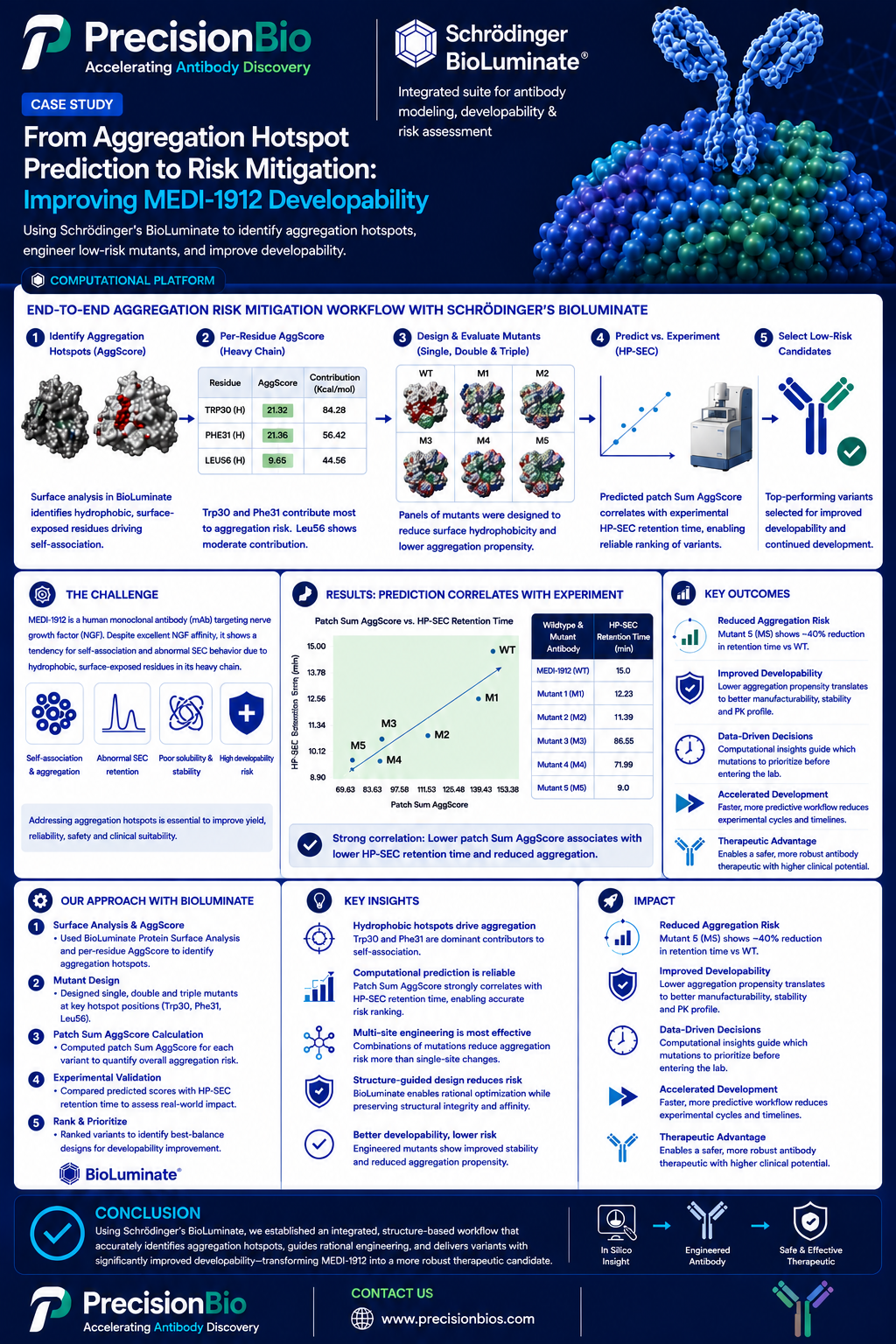
Common Client Challenges
- Antibody aggregation and self-association
- Poor developability profiles
- Limited visibility into structural liabilities
- Costly experimental screening
- Delayed candidate selection
- Difficulty balancing affinity and developability
Structure-Guided Workflow
- 01
Homology Modeling of the MEDI-1912 Fv
We built a high-quality 3D homology model of the MEDI-1912 variable fragment (Fv) using Schrödinger BioLuminate, with attention to CDR loop geometry, VH/VL pairing, and surface exposure. The model serves as the structural substrate for every downstream aggregation and developability calculation.
- 02
Aggregation Hotspot Identification
Surface-exposed hydrophobic patches were mapped using AggScore and Spatial Aggregation Propensity (SAP). The analysis localized the dominant aggregation liability to a hydrophobic patch in CDR-H2 / CDR-H3, in agreement with reported MEDI-1912 self-association behavior.
- 03
In-Silico Residue Scanning and Mutation Design
Residue scanning tested polar and charged substitutions across the hotspot positions, ranking mutants by predicted change in aggregation propensity, hydrophobic patch area, and stability (ΔΔG). Designs that simultaneously reduced hotspot intensity and preserved framework stability were carried forward.
- 04
Re-Scoring of Engineered Variants
Top variants were re-modeled and re-scored end-to-end (AggScore, SAP, surface hydrophobicity, isoelectric point, patch analysis) to confirm that the engineered mutations eliminated or attenuated the hotspot rather than shifting it elsewhere on the Fv surface.
- 05
Binding-Site Preservation Check
Because the hotspot overlaps the paratope, every candidate mutation was filtered against the binding interface to retain key antigen-contacting residues, ensuring affinity and specificity were not compromised by aggregation engineering.
- 06
Developability Ranking and Candidate Selection
Engineered variants were ranked on an integrated developability score combining aggregation propensity, predicted solubility, thermal stability, and charge distribution, producing a short list of redesigned MEDI-1912 candidates ready for wet-lab confirmation.
Key Results
- Aggregation hotspot in CDR-H2 / CDR-H3 localized in silico
- Predicted aggregation propensity reduced across top variants
- Surface hydrophobic patch area decreased
- Antigen-binding residues preserved
- Developability profile improved (solubility, stability, charge)
- Wet-lab screening focused on a small, high-confidence panel
Conclusion
Combining homology modeling, AggScore / SAP hotspot mapping, and in-silico residue scanning in Schrödinger BioLuminate turned MEDI-1912 — an antibody with well-documented self-association liabilities — into a tractable engineering problem. The workflow localized the aggregation hotspot, designed mutations that reduced predicted aggregation propensity, preserved antigen binding, and produced a short, high-confidence panel of developable candidates ready for biophysical confirmation.
Frequently Asked Questions
What causes antibody aggregation during development?
Antibody aggregation is driven primarily by exposed hydrophobic patches on the variable region surface, charge imbalances, partial unfolding under stress (heat, pH, agitation, freeze-thaw), and self-association through complementary CDR surfaces. These liabilities are often encoded in the sequence and only revealed during manufacturing, formulation, or long-term storage.
How can aggregation hotspots be identified before extensive laboratory testing?
Aggregation hotspots can be predicted from a 3D structural model of the antibody Fv using tools such as Schrödinger BioLuminate's AggScore and Spatial Aggregation Propensity (SAP). These methods map surface-exposed hydrophobic and charge-driven regions and flag specific residues responsible for self-association, allowing teams to triage liabilities computationally before committing to expression and biophysical screening.
Why is developability assessment important during antibody discovery?
Developability assessment catches manufacturability and formulation risks — aggregation, low solubility, poor thermal stability, high viscosity, chemical degradation — while the candidate panel is still small and easy to redesign. Acting early avoids late-stage attrition, reduces the cost of failed CMC campaigns, and increases the probability that the lead antibody reaches the clinic.
What is an aggregation hotspot?
An aggregation hotspot is a localized region on the antibody surface — typically a cluster of exposed hydrophobic residues, often in or near the CDRs — that drives self-association and oligomer formation. Hotspots are usually a small number of specific residues, which makes them attractive targets for structure-guided mutation.
Can computational predictions accurately identify aggregation risk?
Modern structure-based predictors (AggScore, SAP, hydrophobic patch analysis, electrostatic surface mapping) correlate well with experimentally observed aggregation and self-association, especially when applied to good-quality homology models and combined with stability and solubility scores. They are not a replacement for biophysical characterization, but they are highly effective for triaging candidates and prioritizing mutations.
How can antibody engineering reduce aggregation?
Aggregation can be reduced by replacing exposed hydrophobic residues in aggregation hotspots with polar or charged residues, disrupting complementary self-association surfaces, optimizing surface charge distribution, and stabilizing the framework. Structure-guided residue scanning makes it possible to design mutations that lower aggregation propensity while preserving antigen binding and overall stability — as demonstrated here for MEDI-1912.
Ready to strengthen your antibody developability?
Talk to our team about applying structure-guided aggregation risk mitigation to your antibody program and advancing more developable candidates.