[ Case Study ] · 2026
AI-Driven Mapping of the HER2-Herceptin Antibody-Antigen Interface
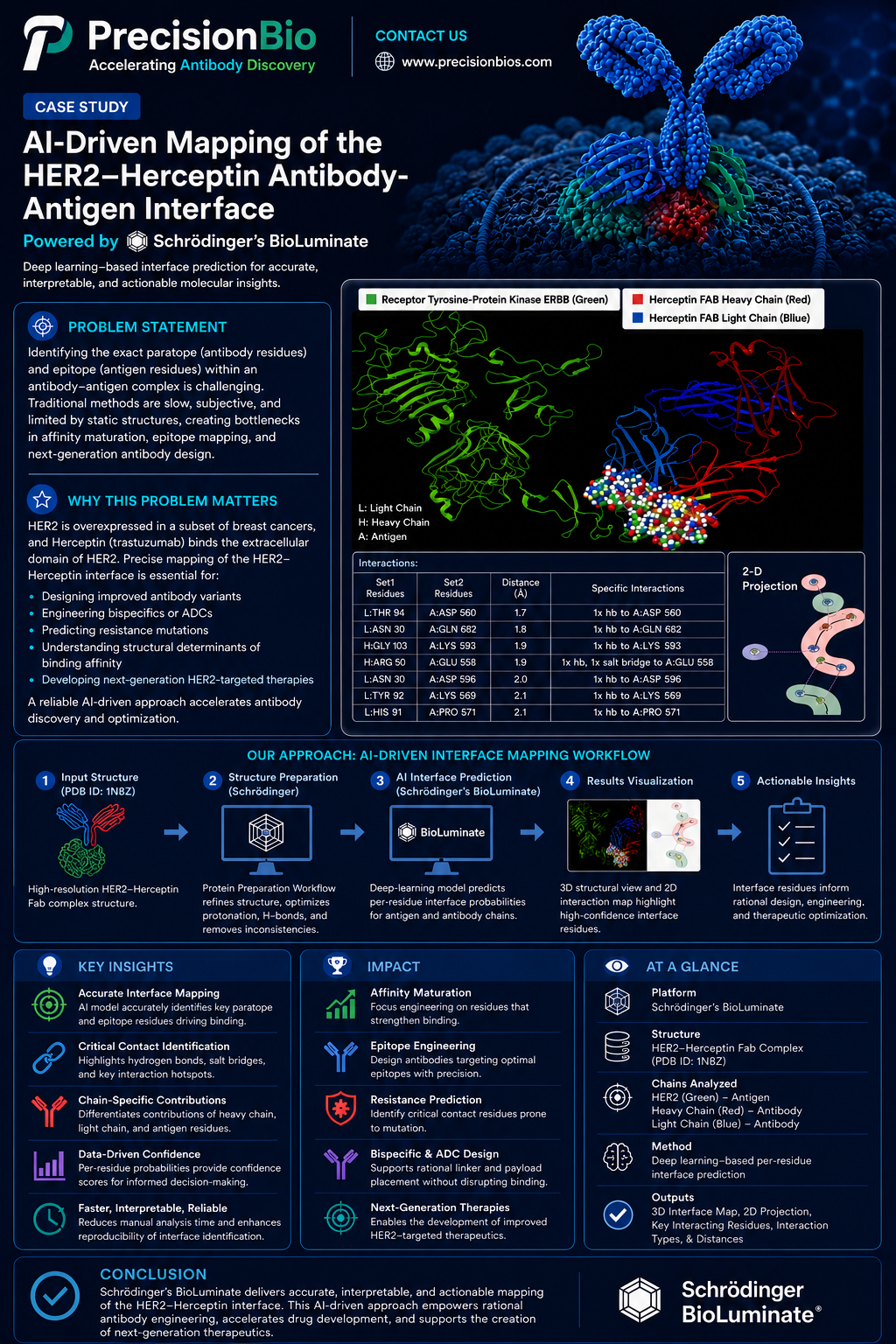
Using AI-driven structural modeling, we mapped the HER2-Herceptin antibody-antigen interface to identify critical binding determinants and accelerate data-driven antibody development.
Common Client Challenges
- Limited understanding of binding mechanisms
- Affinity maturation bottlenecks
- Difficulty engineering bispecifics and ADCs
- Limited visibility into antibody-antigen contacts
- Need for faster structure-based decisions
AI-Driven Interface Mapping Workflow
- 01
Structure Acquisition
We assemble the HER2-Herceptin complex from experimentally determined PDB structures and complement them with AI-predicted models (AlphaFold-Multimer and equivalent complex predictors) to produce a high-quality starting structure for downstream interface analysis.
- 02
Interface Residue Identification
Residue-level paratope and epitope contacts are extracted from the complex using distance and buried-surface-area criteria, producing an annotated contact map that highlights every antibody residue engaging HER2 and the reciprocal epitope footprint on the antigen.
- 03
Hotspot Scoring & Energetic Analysis
Each interface residue is scored for energetic contribution using alanine scanning, MM-GBSA decomposition, and AI-based affinity predictors. The output is a ranked list of hotspot residues that drive binding affinity and specificity.
- 04
Visualization of Antibody-Antigen Contacts
Interface maps, contact networks, and hotspot overlays are rendered on the 3D complex so program teams can visually inspect paratope-epitope geometry, hydrogen bond networks, and hydrophobic patches that govern HER2 recognition.
- 05
Hand-off to Affinity Maturation, Bispecific & ADC Design
Prioritized hotspots and contact maps feed directly into downstream programs — guiding CDR mutagenesis for affinity maturation, second-arm placement for bispecifics, and conjugation site selection for antibody-drug conjugates.
Key Results
- Detailed paratope-epitope contact map
- Prioritized hotspot residues for mutagenesis
- Faster structure-based decision making
- Reusable template for HER2-targeting programs
Conclusion
AI-driven interface mapping turns the HER2-Herceptin complex into an actionable engineering blueprint — accelerating affinity maturation, bispecific design, and ADC development for HER2-targeting programs, and providing a reusable template for structure-guided antibody discovery.
Frequently Asked Questions
What is antibody-antigen interface mapping?
Antibody-antigen interface mapping is the structural analysis of the contact region between an antibody and its target antigen. It identifies the paratope residues on the antibody and the epitope residues on the antigen, along with the bonds and energetic contributions that drive binding — providing the structural basis for rational antibody engineering.
Why is epitope mapping important in antibody discovery?
Epitope mapping reveals exactly where on the antigen an antibody binds, which determines specificity, mechanism of action, and competitive landscape. It is essential for differentiating candidates, avoiding patent conflicts, supporting biologics license filings, and engineering antibodies that block or activate the right biological pathway.
What is a paratope?
A paratope is the part of an antibody that physically contacts the antigen — typically composed of residues from the six complementarity-determining regions (CDRs) of the heavy and light chains. Identifying paratope residues at the atomic level is the foundation for affinity maturation and developability optimization.
How can AI improve antibody engineering?
AI accelerates antibody engineering by predicting complex structures (e.g. AlphaFold-Multimer), scoring mutational effects on affinity and stability, and prioritizing sequence variants in silico. This compresses design-build-test cycles and lets teams explore far larger sequence spaces than traditional wet-lab screening alone.
How does interface mapping support affinity maturation?
Interface mapping pinpoints the hotspot residues that contribute most to binding affinity. Affinity maturation campaigns then focus mutagenesis on those positions and their neighbors, raising the hit rate of beneficial mutations and reducing the number of variants that need to be expressed and tested.
Why is structural insight important during antibody optimization?
Structural insight tells engineers why an antibody binds the way it does — not just that it binds. That mechanistic understanding makes it possible to improve affinity, fix developability liabilities, and design bispecifics or ADCs without breaking the original binding mode.
Related Applications
AI-driven antibody-antigen interface mapping can support:
- Antibody discovery and optimization
- Affinity maturation
- Epitope mapping
- Paratope identification
- Bispecific antibody development
- Antibody-drug conjugate (ADC) design
- HER2 therapeutic development
- Structure-guided antibody engineering
- Computational antibody design
Get in touch
Ready to accelerate your antibody discovery with AI?
Talk to our team about applying AI-driven interface mapping to your antibody program — and unlocking data-driven candidate optimization.