[ Insight ] · 2026
Antibody Characterization by Liquid Chromatography and Mass Spectrometry (LC-MS/MS)
Comprehensive LC-MS/MS workflows — intact mass, subunit mass, peptide mapping, glycosylation, and sequence variant analysis — for antibody quality control, developability assessment, and production optimization.
Common Client Challenges
- Uncertain Molecule Identity
- Incomplete Structural Characterization
- Glycosylation Variability
- Unexpected Product Heterogeneity
- Sequence Variants and Production Errors
- Limited Confidence in Candidate Quality
- Regulatory Readiness Concerns
- Understanding Critical Quality Attributes (CQAs)
- Accelerating Candidate Selection
- Meeting regulatory expectations for biologics characterization
What LC-MS/MS Reveals
Intact Mass Analysis
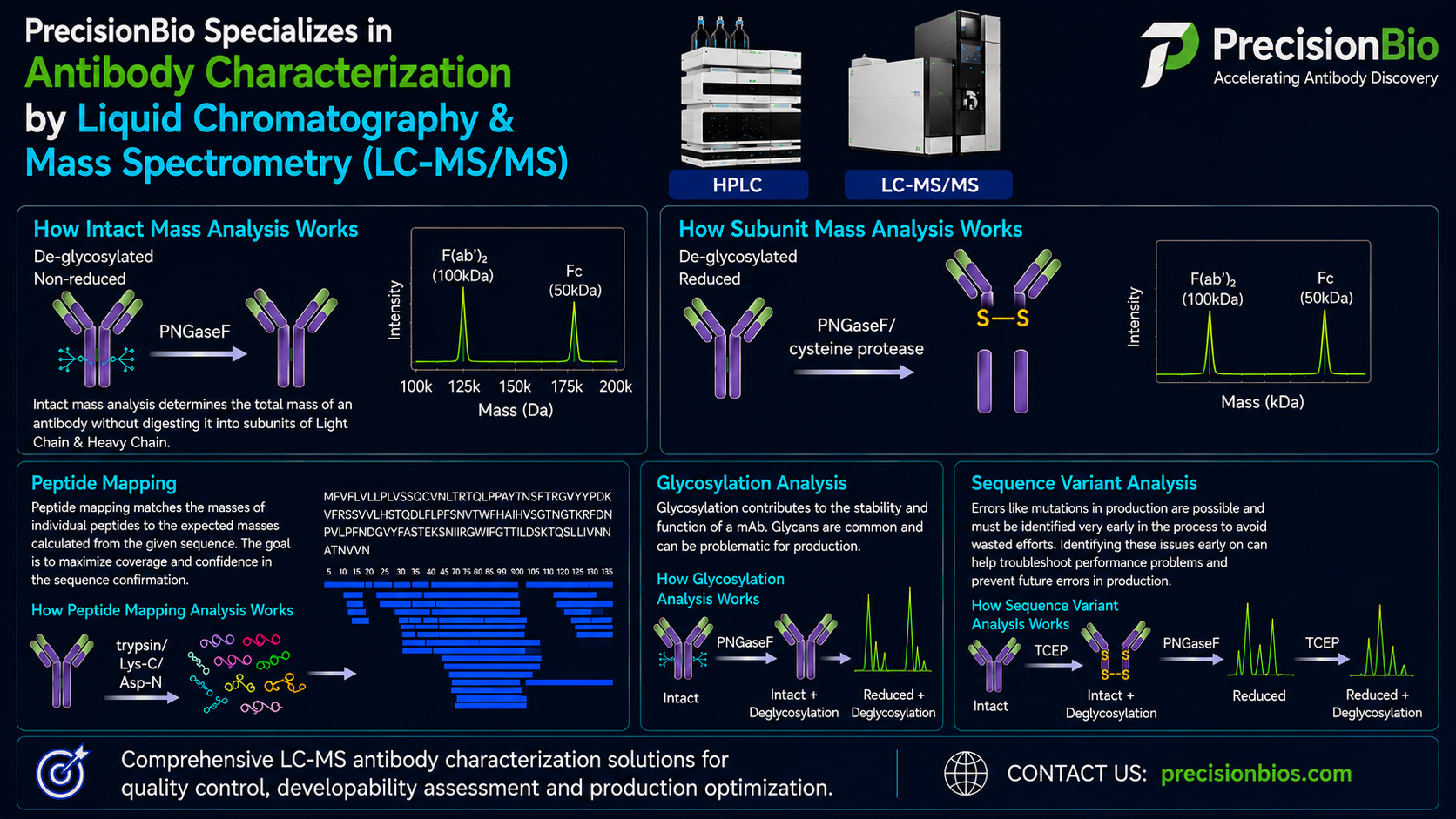
Intact mass analysis determines the total mass of an antibody without digesting it into Light Chain and Heavy Chain subunits. The deglycosylated, non-reduced sample is treated with PNGaseF and analyzed by LC-MS, producing a clean spectrum that confirms the expected mass of the full F(ab')₂ and Fc-containing species and reveals unexpected modifications or clipping.
Subunit Mass Analysis
Subunit mass analysis reduces and deglycosylates the antibody using PNGaseF and a cysteine protease (e.g. IdeS) to release Fc and F(ab')₂ subunits. Each subunit is then measured individually by LC-MS, giving higher mass accuracy and clearer detection of low-level modifications than intact analysis alone.
Peptide Mapping
Peptide mapping matches the masses of individual peptides to the expected masses calculated from the given sequence. The goal is to maximize coverage and confidence in the sequence confirmation. The antibody is digested with trypsin, Lys-C, or Asp-N and the resulting peptides are separated by LC and identified by MS/MS, providing residue-level sequence verification and PTM localization.
Glycosylation Analysis
Glycosylation contributes to the stability and function of a mAb. Glycans are common and can be problematic for production. The intact antibody is profiled, then PNGaseF-released and analyzed both intact + deglycosylated and reduced + deglycosylated to quantify N-glycan species, monitor glycoform distribution, and flag aglycosylated or atypical structures.
Sequence Variant Analysis
Errors like mutations in production are possible and must be identified very early in the process to avoid wasted efforts. Identifying these issues early on can help troubleshoot performance problems and prevent future errors in production. Samples are analyzed intact, intact + deglycosylated (TCEP / PNGaseF), reduced, and reduced + deglycosylated to detect low-abundance sequence variants with high confidence.
Key Benefits
- Confident sequence and mass confirmation of antibody candidates
- Early detection of modifications, variants, and clipped species
- Quantitative glycan profiling for comparability and developability
- High-coverage peptide mapping for residue-level QC
- Reduced risk of late-stage manufacturing surprises
- Data packages suitable for regulatory submissions
Conclusion
Together, intact mass, subunit mass, peptide mapping, glycosylation, and sequence variant analysis form a complete LC-MS/MS toolkit for antibody characterization — supporting quality control, developability assessment, production optimization, and regulatory submissions with high-confidence structural evidence.
Frequently Asked Questions
What is LC-MS/MS antibody characterization?
LC-MS/MS combines liquid chromatography with tandem mass spectrometry to measure antibody mass, subunit mass, peptide sequences, glycans, and sequence variants — providing the orthogonal evidence needed to confirm identity, purity, and post-translational modifications of a therapeutic antibody.
When is intact mass analysis used vs. subunit mass analysis?
Intact mass analysis confirms the overall molecular weight of the full antibody and detects gross modifications. Subunit mass analysis, performed after reduction and deglycosylation, gives higher mass accuracy for individual Fc and F(ab')₂ subunits and resolves low-level modifications that intact analysis cannot.
Why is peptide mapping important for antibody characterization?
Peptide mapping provides residue-level confirmation of the antibody sequence and localizes post-translational modifications (oxidation, deamidation, glycation, N/C-terminal variants). High sequence coverage is the cornerstone of identity, purity, and comparability assessments.
What does glycosylation analysis reveal?
It quantifies the N-glycan profile attached to the Fc region — including high-mannose, galactosylation, sialylation, fucosylation, and aglycosylation — which influence stability, effector function (ADCC/CDC), pharmacokinetics, and manufacturability of the antibody.
How does sequence variant analysis help in production?
Sequence variant analysis detects low-abundance amino-acid substitutions introduced during cell-line construction or expression. Identifying variants early helps troubleshoot performance problems, refine clones, and prevent costly downstream failures.
What enzymes are used in LC-MS sample preparation?
PNGaseF is used to release N-glycans, cysteine proteases such as IdeS are used to generate subunits, and trypsin, Lys-C, or Asp-N are used for peptide mapping digests. TCEP is commonly used as a reductant.
Is LC-MS suitable for biosimilar comparability and regulatory work?
Yes. Intact mass, subunit mass, peptide mapping, and glycan profiling are routinely included in biosimilar comparability exercises and biologics regulatory submissions because they provide high-resolution, orthogonal evidence of structural identity.
How does LC-MS support developability assessment?
By detecting PTMs (oxidation, deamidation, glycation), terminal heterogeneity, aggregation-prone modifications, and atypical glycoforms early in discovery, LC-MS flags developability liabilities before candidates progress to expensive optimization or manufacturing stages.
Related Applications
LC-MS/MS antibody characterization can support:
- Quality control and release testing
- Developability assessment
- Biosimilar characterization and comparability
- Glycoengineering and glycan profiling
- Post-translational modification (PTM) analysis
- Sequence variant and mutation detection
- Stability and forced-degradation studies
- Formulation development
- Process and cell-line development
- Discovery support and lead characterization
- Bispecific and ADC analysis
- Manufacturing support
- Regulatory submissions
Get in touch
Ready to characterize your antibody by LC-MS/MS?
Talk to our team about applying intact mass, subunit mass, peptide mapping, glycan profiling, and sequence variant analysis to your program.