[ Insight ] · 2026
Triaging Diverse Antibody Candidates
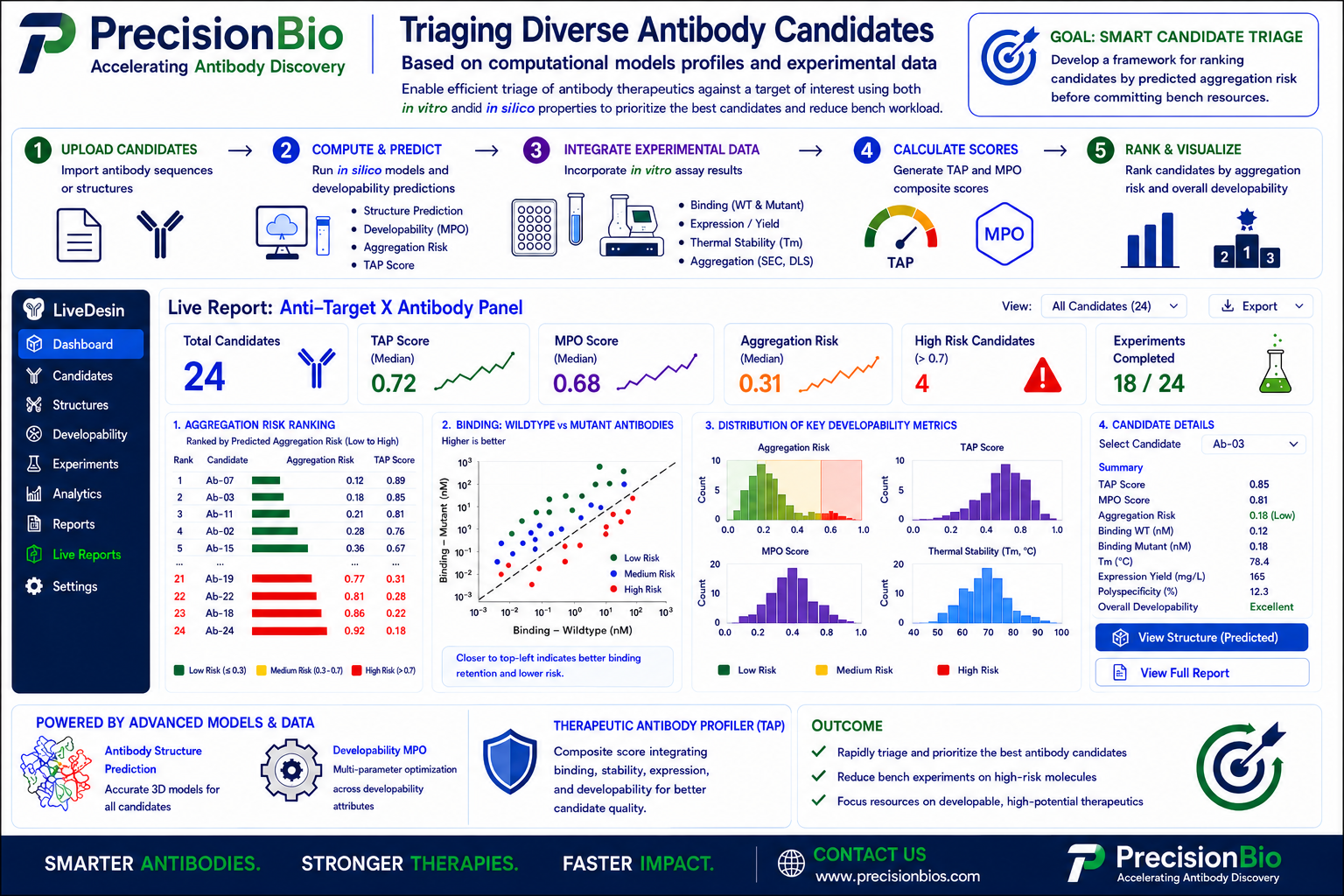
Triaging diverse antibody candidates enables efficient triage of antibody therapeutics against a target of interest using both in vitro and in silico properties to prioritize the best candidates and reduce bench workload.
Common Client Challenges
- Too many candidates, too little time
- High experimental costs
- Late discovery of developability risks
- Difficulty comparing attributes across diverse candidates
- Lack of standardized ranking
- Limited visibility into developability liabilities
- Balancing potency vs developability
- Managing large, heterogeneous antibody panels
Triage Workflow
- 01
Candidate Intake
Consolidate the diverse antibody panel — sequences, format, target, and any pre-existing assay data — into a single, structured candidate set ready for evaluation.
- 02
In Vitro Properties
Capture experimental readouts (expression, binding, thermal stability, basic biophysical QC) so wet-lab evidence anchors the downstream ranking.
- 03
In Silico Properties
Run structure- and sequence-based developability profiling — Therapeutic Antibody Profiler (TAP) metrics, aggregation hotspot prediction, and liability scanning — to surface risks before they reach the bench.
- 04
Multi-Attribute Scoring (MPO)
Combine in vitro and in silico attributes into a multi-parameter optimization score, with weights tuned to program priorities (e.g. potency vs manufacturability).
- 05
Ranking & Shortlist
Produce a transparent, reproducible ranked shortlist that highlights top performers, flags risk-carrying candidates, and explains the tradeoffs behind each placement.
- 06
Hand-off to Development
Deliver the prioritized panel — with all underlying evidence — to downstream optimization, developability, or lead-selection teams for confident progression.
Key Results
- Reduced bench workload through early in silico triage
- Faster prioritization of lead antibody candidates
- Earlier identification of developability liabilities
- Transparent, multi-attribute ranking across diverse panels
- Balanced potency and developability decision making
- Reusable workflow across discovery programs
Conclusion
Combining in vitro evidence with in silico developability profiling and multi-attribute ranking turns a diverse antibody panel into a transparent, prioritized shortlist — accelerating lead selection while reducing bench workload and late-stage risk.
Frequently Asked Questions
What does it mean to triage antibody candidates?
Triaging antibody candidates means systematically evaluating a diverse panel against shared criteria — binding, expression, stability, and developability — so the strongest candidates advance and weaker ones are deprioritized before expensive downstream work.
Why combine in vitro and in silico properties for triage?
In vitro data confirms real biological behavior, while in silico predictions flag liabilities (aggregation hotspots, charge issues, post-translational risks) that may not surface in early assays. Combining both prevents late-stage surprises and accelerates decision making.
How is developability assessed during triage?
Developability is assessed using structure- and sequence-based metrics (e.g. TAP, hydrophobicity and charge patches, aggregation hotspot prediction) alongside experimental indicators such as expression yield, monomer purity, and thermal stability.
What is multi-parameter optimization (MPO) in antibody selection?
MPO is a scoring approach that combines multiple weighted attributes — potency, stability, developability risk, manufacturability — into a single ranking, making tradeoffs explicit instead of relying on ad-hoc judgment.
How does triage reduce bench workload?
By using in silico profiling to filter out high-risk or low-quality candidates early, the wet lab only spends resources on candidates with a realistic chance of progressing — cutting assay volume, material requirements, and turnaround time.
Can this workflow handle large, diverse antibody panels?
Yes. The workflow is built to standardize evaluation across heterogeneous panels — different formats, scaffolds, or sources — so candidates can be compared on equal footing.
How does triage balance potency with developability?
Both attributes are scored independently and combined through the MPO, so high-potency candidates with severe developability risks are not auto-promoted, and developable candidates with weak potency are not auto-retained.
What is the output of the triage workflow?
A ranked shortlist of antibody candidates with attached evidence — in vitro readouts, in silico flags, and combined scores — ready for hand-off to optimization, developability, or lead-selection teams.
Related Applications
Triaging diverse antibody candidates can support:
- Antibody discovery and lead selection
- Developability assessment
- Aggregation and liability profiling
- Therapeutic Antibody Profiler (TAP) analysis
- Multi-parameter optimization (MPO)
- In silico antibody screening
- Bispecific and multi-specific candidate triage
- Antibody-drug conjugate (ADC) candidate selection
- Lead optimization and affinity maturation triage
- Computational antibody engineering
Get in touch
Ready to triage your antibody panel?
Talk to our team about applying this workflow to your program — from candidate intake to ranked, developability-aware shortlists.