[ Technical Note ] · 2026
Computational Approaches to Antibody Humanization
An overview of in silico frameworks for CDR grafting and sequence optimization — humanization strategies, structural considerations, framework ranking, and germline-library scoring for therapeutic antibody design.
Common Client Challenges
- How can I reduce immunogenicity without sacrificing antibody performance?
- Which human germline framework should I choose?
- Why did my humanized antibody lose binding affinity?
- Is simple CDR grafting enough?
- Which framework residues should remain unchanged?
- Can computational methods reduce experimental iterations?
- How can I accelerate antibody optimization?
- How do I compare multiple humanization designs?
- Can humanization improve developability?
- What if my antibody contains unusual CDR conformations?
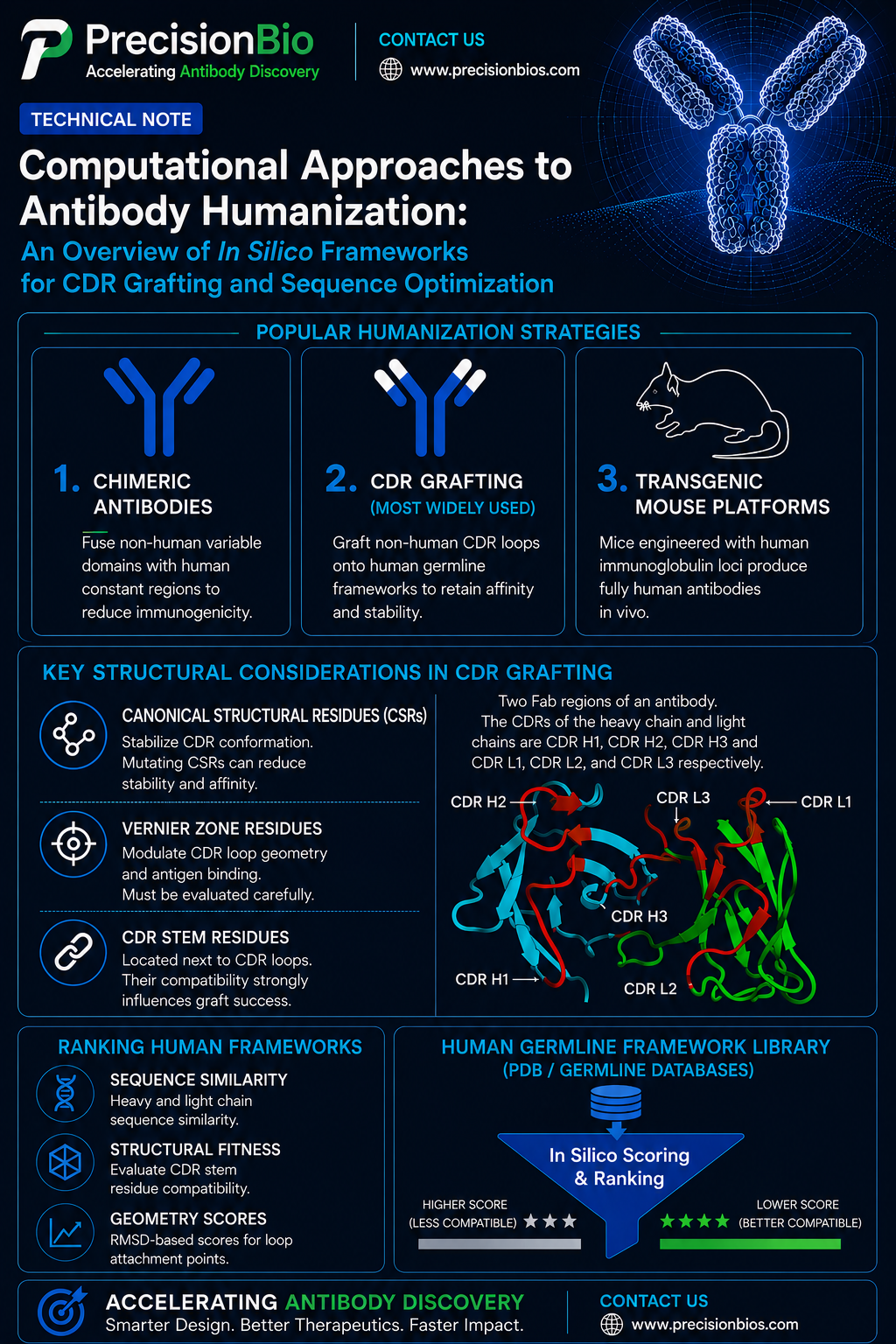
Popular Humanization Strategies
Chimeric Antibodies
Fuse non-human variable domains with human constant regions to reduce immunogenicity while retaining the original antigen-binding specificity. Chimeric formats are a fast first step but still carry non-human variable framework sequences.
CDR Grafting (most widely used)
Graft non-human CDR loops onto human germline frameworks to retain affinity and stability while presenting a predominantly human sequence. Success depends on framework selection and on preserving structural residues that support CDR conformation.
Transgenic Mouse Platforms
Mice engineered with human immunoglobulin loci produce fully human antibodies in vivo. The platform avoids post-hoc humanization but requires animal-based discovery and offers less control over framework choice than computational design.
Key Structural Considerations in CDR Grafting
Canonical Structural Residues (CSRs)
Conserved framework amino acids that stabilize CDR conformation. Mutating CSRs during grafting can reduce stability and affinity, so they must be identified and preserved when selecting a human framework.
Vernier Zone Residues
Framework amino acids located beneath the CDR loops that modulate loop geometry and antigen binding. Vernier residues frequently require careful, case-by-case evaluation during humanization.
CDR Stem Residues
Residues located next to the CDR loops that anchor them to the framework. Their compatibility with the chosen human framework strongly influences graft success and the retention of binding affinity.
Two Fab regions of an antibody contain the CDRs of the heavy chain (CDR H1, CDR H2, CDR H3) and the light chain (CDR L1, CDR L2, CDR L3). Each loop must be supported by a compatible framework for the humanized antibody to retain its native binding mode.
Ranking Human Frameworks
Sequence Similarity
Heavy and light chain sequence similarity between the non-human parent and candidate human germline frameworks is the first filter for framework selection.
Structural Fitness
Evaluate CDR stem residue compatibility and overall structural fit of the grafted CDRs onto the candidate framework before committing to experimental construction.
Geometry Scores
RMSD-based scores for CDR loop attachment points and overall framework geometry quantify how well a candidate framework will support the original CDR conformation.
Human Germline Framework Library
Candidate frameworks are drawn from curated PDB and germline databases and passed through an in silico scoring and ranking pipeline. Higher scores indicate less compatible frameworks; lower scores indicate better structural and sequence compatibility with the parent antibody's CDRs. Top-ranked frameworks are then prioritized for experimental validation.
Frequently Asked Questions
What is antibody humanization?
Antibody humanization is the process of modifying a non-human antibody — typically derived from a mouse — to reduce its immunogenicity while preserving antigen-binding affinity and therapeutic function.
Why is antibody humanization necessary?
Non-human antibodies can trigger immune responses in patients. Humanization reduces this risk, improving safety and increasing the likelihood of clinical success.
What is CDR grafting?
Complementarity-determining region (CDR) grafting transfers the antigen-binding loops from a non-human antibody onto a human antibody framework while attempting to preserve binding specificity.
Why can antibody affinity decrease after humanization?
Framework residues surrounding the CDR loops influence their three-dimensional structure. Changes to these residues may alter antigen recognition and reduce binding affinity.
What are canonical structural residues (CSRs)?
Canonical structural residues are conserved framework amino acids that stabilize CDR conformations. Preserving these residues is often essential for maintaining antibody structure and function.
What are Vernier zone residues?
Vernier residues are framework amino acids located beneath the CDR loops that influence loop orientation and antigen binding. They frequently require careful evaluation during antibody humanization.
What are CDR stem residues?
CDR stem residues anchor the antigen-binding loops to the antibody framework. Their compatibility strongly influences successful CDR grafting.
How do computational humanization methods work?
Computational workflows analyze sequence similarity, structural compatibility, framework geometry, and germline databases to identify optimal human frameworks before experimental testing.
How is the best human framework selected?
Framework selection typically considers human germline similarity, structural compatibility, canonical residue conservation, loop geometry, predicted stability, and developability characteristics.
Is computational humanization a replacement for laboratory validation?
No. Computational methods help prioritize the most promising designs, but experimental validation remains essential to confirm binding, stability, and functional activity.
Can PrecisionBio support antibody humanization projects?
Yes. PrecisionBio combines computational modeling, structural analysis, framework selection, developability assessment, and experimental validation to help optimize therapeutic antibody candidates.
Related Applications
- Antibody humanization
- CDR grafting
- Framework optimization
- Human germline selection
- Immunogenicity reduction
- Sequence optimization
- Structure-guided antibody engineering
- Antibody developability assessment
- Therapeutic antibody optimization
- AI-driven antibody design
- Computational protein engineering
- Antibody affinity preservation
Get in touch
Ready to humanize your antibody with computational design?
Talk to our team about applying in silico framework selection, CDR grafting, and developability assessment to your therapeutic antibody program.