[ Case Study ] · 2026
In Silico Residue Scanning Guides Affinity Maturation
Antibody A6 Targeting IFNGR1
Using Schrödinger BioLuminate to systematically scan interface residues and identify tunable positions for affinity improvement.
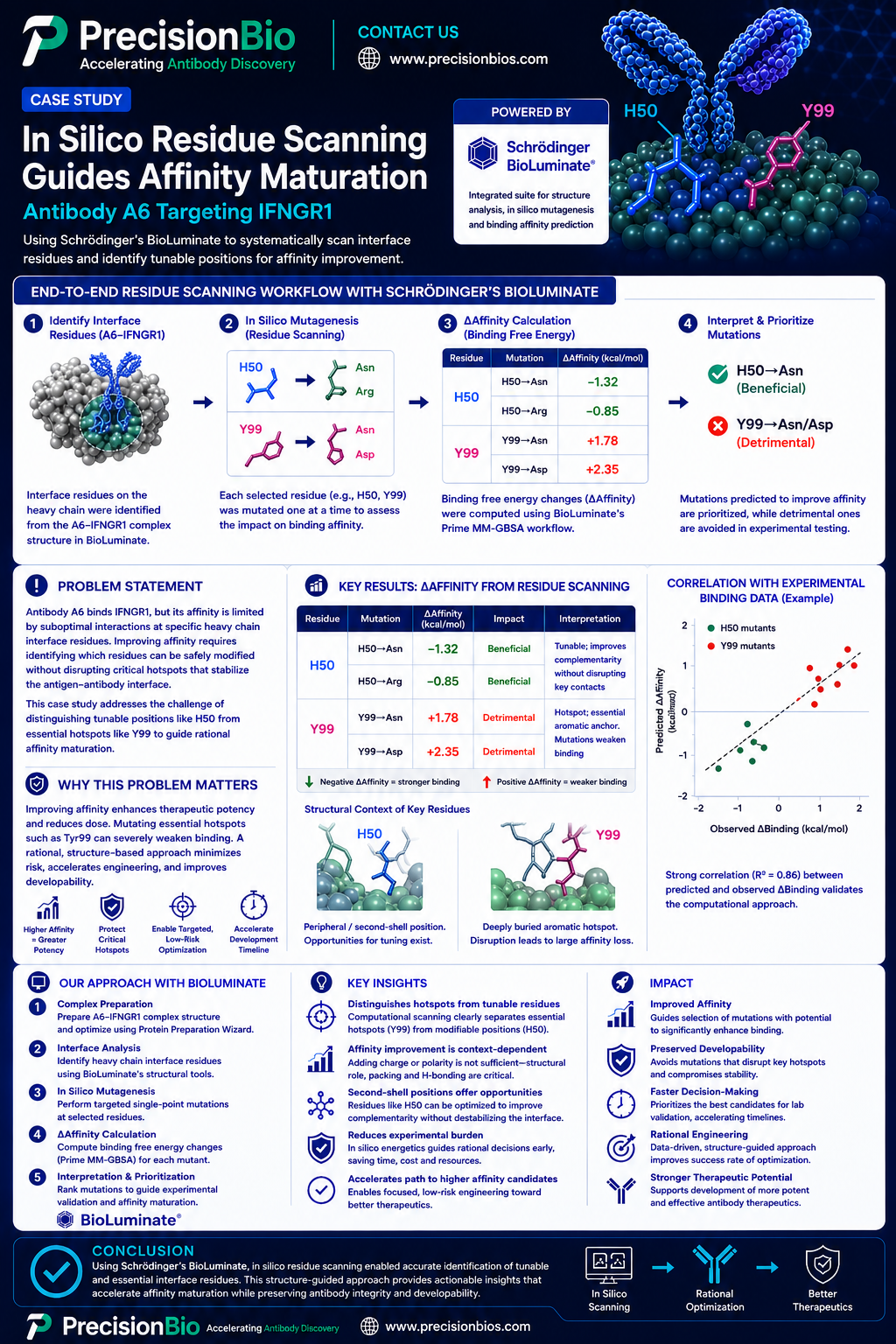
End-to-End Residue Scanning Workflow with Schrödinger's BioLuminate
- 01
Identify Interface Residues (A6–IFNGR1)
Interface residues on the heavy chain were identified from the A6–IFNGR1 complex structure in BioLuminate.
- 02
In Silico Mutagenesis (Residue Scanning)
Each selected residue (e.g., H50, Y99) was mutated one at a time to assess the impact on binding affinity.
- 03
ΔAffinity Calculation (Binding Free Energy)
Binding free energy changes (ΔAffinity) were computed using BioLuminate's Prime MM-GBSA workflow.
- 04
Interpret & Prioritize Mutations
Mutations predicted to improve affinity are prioritized, while detrimental ones are avoided in experimental testing.
Problem Statement
Antibody A6 binds IFNGR1, but its affinity is limited by suboptimal interactions at specific heavy chain interface residues. Improving affinity requires identifying which residues can be safely modified without disrupting critical hotspots that stabilize the antigen–antibody interface.
This case study addresses the challenge of distinguishing tunable positions like H50 from essential hotspots like Y99 to guide rational affinity maturation.
Why This Problem Matters
Improving affinity enhances therapeutic potency and reduces dose. Mutating essential hotspots such as Tyr99 can severely weaken binding. A rational, structure-based approach minimizes risk, accelerates engineering, and improves developability.
- Higher Affinity = Greater Potency
- Protect Critical Hotspots
- Enable Targeted, Low-Risk Optimization
- Accelerate Development Timeline
Key Results: ΔAffinity from Residue Scanning
| Residue | Mutation | ΔAffinity (kcal/mol) | Impact | Interpretation |
|---|---|---|---|---|
| H50 | H50→Asn | −1.32 | Beneficial | Tunable; improves complementarity without disrupting key contacts. |
| H50 | H50→Arg | −0.85 | Beneficial | Tunable; favorable substitution at a second-shell position. |
| Y99 | Y99→Asn | +1.78 | Detrimental | Hotspot; essential aromatic anchor. Mutation weakens binding. |
| Y99 | Y99→Asp | +2.35 | Detrimental | Hotspot disruption; large loss of binding free energy. |
↓ Negative ΔAffinity = stronger binding · ↑ Positive ΔAffinity = weaker binding
Structural Context of Key Residues
H50
Peripheral / second-shell position. Opportunities for tuning exist.
Y99
Deeply buried aromatic hotspot. Disruption leads to large affinity loss.
Correlation with Experimental Binding Data
Strong correlation (R² = 0.86) between predicted ΔAffinity and observed ΔBinding validates the computational approach across both H50 and Y99 mutants.
Our Approach with BioLuminate
- 01
Complex Preparation
Prepare A6–IFNGR1 complex structure and optimize using Protein Preparation Wizard.
- 02
Interface Analysis
Identify heavy chain interface residues using BioLuminate's structural tools.
- 03
In Silico Mutagenesis
Perform targeted single-point mutations at selected residues.
- 04
ΔAffinity Calculation
Compute binding free energy changes (Prime MM-GBSA) for each mutant.
- 05
Interpretation & Prioritization
Rank mutations to guide experimental validation and affinity maturation.
Key Insights
Distinguishes hotspots from tunable residues
Computational scanning clearly separates essential hotspots (Y99) from modifiable positions (H50).
Affinity improvement is context-dependent
Adding charge or polarity is not sufficient — structural role, packing and H-bonding are critical.
Second-shell positions offer opportunities
Residues like H50 can be optimized to improve complementarity without destabilizing the interface.
Reduces experimental burden
In silico energetics guides rational decisions early, saving time, cost and resources.
Accelerates path to higher affinity candidates
Enables focused, low-risk engineering toward better therapeutics.
Impact
Improved Affinity
Guides selection of mutations with potential to significantly enhance binding.
Preserved Developability
Avoids mutations that disrupt key hotspots and compromise stability.
Faster Decision-Making
Prioritizes the best candidates for lab validation, accelerating timelines.
Rational Engineering
Data-driven, structure-guided approach improves success rate of optimization.
Stronger Therapeutic Potential
Supports development of more potent and effective antibody therapeutics.
Conclusion
Using Schrödinger BioLuminate, in silico residue scanning enabled accurate identification of tunable and essential interface residues. This structure-guided approach provides actionable insights that accelerate affinity maturation while preserving antibody integrity and developability.
Ready to accelerate your antibody program?
Talk to our team about how structure-guided in silico residue scanning can de-risk and speed up your affinity maturation campaigns.